Mostrando entradas con la etiqueta B1. Mostrar todas las entradas

27/9/14

Question Tags practice


See if you can finish the following sentences with the correct question tag. The first ones are relatively easy, but then they get more difficult!


  • You don't like me, ... ...?
  • It isn't raining, ... ...?
  • You've done your homework, ... ...?
  • I'm not late, ... ...?
  • I'm invited to your party, ... ...?
  • You like German food, ... ...?
  • You'll come to my party, ... ...?
  • You remembered to feed the cat, ... ...?
  • Let's play tennis, ... ...?
  • There's a problem here, ... ...?
  • He never says a word, ... ...?
  • Nobody came to your party, ... ...?
  • Don't forget, ... ...?
  • You think you're clever, ... ...?
  • So you think you're clever, ... ...?

12/10/13

WE THOUGHT WE WERE ASLEEP

Today I show you my second book for the English Readers Collection:

We thought we were asleep


LEVEL: A2-B1. 4ESO, 1 Bahillerato.
AUTHOR: Rafael Alcolea Harold 
Author's webpage: www.rafaelalcolea@blogspot.com.es
Genre: Science Fiction, Young Adult.
Pages: 20
 PLOT:
 
Every year the goverments around the world give us a pill to sleep for some hours. The whole planet remains asleep at the same time, but... What would happen if you realise that you are not sleeping when you are supposed to be?
 The protagonist discovers a terrible secret hidden by the rulers of our world.
Will he escape from his fate?


Link Download for FREE: 
 http://www.bubok.es/libros/227897/WE-THOUGHT-WE-WERE-ASLEEP

Note for teachers: You are allowed to use this material in class.
Aquellos profesores que quieran usar estos materiales en clase pueden hacerlo. Solo deberán indicar la autoría del libro.


19/6/13

THE NEXT VICTIM

Today, we present the first title of our collection of MyPlaceforEnglish's Readers in English:


Title: The Next Victim.
Author: R. Alcolea Harold.
Genre: Mystery, vampires.
Pages: 50.
Level: Intermediate (A2, B1) / Bachillerato (1,2)
Price: 0.89€ / $1.19
Link to buy the Ebook  at Amazon: http://www.amazon.com/THE-NEXT-VICTIM-ebook/dp/B00DESIHXC/ref=sr_1_3?s=digital-text&ie=UTF8&qid=1371597773&sr=1-3&keywords=the+next+victim

This text is appropriate to be used in EFL Classroom. It includes questions for the understanding of the story and further activities to be carried out in class.

También podéis adquirirlo en Amazon España o cualquier país del mundo. Este libro es el primer título de la colección de lecturas para estudiantes de Inglés de nuestra web. Esperamos os guste. Se puede descargar y trabajar en clase por su económico precio.

Enlace de Amazon españa: http://www.amazon.es/THE-NEXT-VICTIM-ebook/dp/B00DESIHXC/ref=sr_1_3?s=digital-text&ie=UTF8&qid=1371597532&sr=1-3&keywords=rafael+alcolea

22/10/12

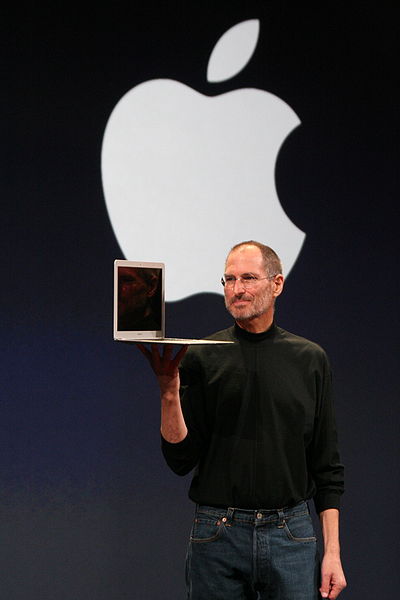
READING ABOUT... STEVE JOBS (APPLE'S BRAIN)


Steve Jobs, the American businessman and technology visionary who is best known as the co-founder, chairman, and chief executive officer of Apple Inc, was born on February 24, 1955. His parents were two University of Wisconsin graduate students, Joanne Carole Schieble and Syrian-born Abdulfattah Jandali. They were both unmarried at the time. Jandali, who was teaching in Wisconsin when Steve was born, said he had no choice but to put the baby up for adoption because his girlfriend's family objected to their relationship.
      Steve Jobs
The baby was adopted at birth by Paul Reinhold Jobs (1922–1993) and Clara Jobs (1924–1986). Later, when asked about his "adoptive parents," Jobs replied emphatically that Paul and Clara Jobs "were my parents." He stated in his authorized biography that they "were my parents 1,000%." Unknown to him, his biological parents would subsequently marry (December 1955), have a second child, novelist Mona Simpson, in 1957, and divorce in 1962. The Jobs family moved from San Francisco to Mountain View, California when Steve was five years old. The parents later adopted a daughter, Patti. Paul was a machinist for a company that made lasers, and taught his son rudimentary electronics and how to work with his hands. The father showed Steve how to work on electronics in the family garage, demonstrating to his son how to take apart and rebuild electronics such as radios and televisions. As a result, Steve became interested in and developed a hobby of technical tinkering. Clara was an accountant who taught him to read before he went to school. Jobs's youth was riddled with frustrations over formal schooling. At Monta Loma Elementary school in Mountain View, he was a prankster whose fourth-grade teacher needed to bribe him to study. Jobs tested so well, however, that administrators wanted to skip him ahead to high school—a proposal his parents declined. Jobs then attended Cupertino Junior High and Homestead High School in Cupertino, California. During the following years Jobs met Bill Fernandez and Steve Wozniak, a computer whiz kid. Following high school graduation in 1972, Jobs enrolled at Reed College in Portland, Oregon. Reed was an expensive college which Paul and Clara could ill afford. They were spending much of their life savings on their son's higher education.

Jobs dropped out of college after six months and spent the next 18 months dropping in on creative classes, including a course on calligraphy. He continued auditing classes at Reed while sleeping on the floor in friends' dorm rooms, returning Coke bottles for food money, and getting weekly free meals at the local Hare Krishna temple In 1976, Wozniak invented the Apple I computer. Jobs, Wozniak, and Ronald Wayne, an electronics industry worker, founded Apple computer in the garage of Jobs's parents in order to sell it.

They received funding from a then-semi-retired Intel product-marketing manager and engineer Mike Markkula. Through Apple, Jobs was widely recognized as a charismatic pioneer of the personal computer revolution and for his influential career in the computer and consumer electronics fields. Jobs also co-founded and served as chief executive of Pixar Animation Studios; he became a member of the board of directors of The Walt Disney Company in 2006, when Disney acquired Pixar. Jobs died at his California home around 3 p.m. on October 5, 2011, due to complications from a relapse of his previously treated pancreatic cancer. Source: Wikipedia

Comprehension:

  1. Steve Jobs never knew who his real parents were.
    a.
    True
    b.
    False
  2. His adoptive parents were rich.
    a.
    True.
    b.
    False.
  3. Jobs was a university graduate.
    a.
    True
    b.
    False

8/9/12

KING ARTHUR AND HIS KNIGHTS


KING ARTHUR AND HIS KNIGHTS. This is the first book of a series of Cheap Graded Readers for Students. Due to the difficult times we are living in we cannot spend too much money in school books, so this is our economic proposal.

This books has also activities carried out by INTERMEDIATE students ( A2, B1, Bachillerato 1, 2) or by those who want to update their "English" reading comprehension .This book can be use in the English classroom in an easy and effective way, since the students can dowload the book at home and print it for the cheapest price. They don't have to wait to get the book for two weeks , they will get it in five minutes!


KING ARTHUR LEGEND
If you want to read the book press the cover.
 
 
Nota para España:
Este libro pertenece a una nueva colección de lecturas graduadas para el estudiante de Inglés. La Leyenda del Rey Arturo, está destinado a estudiantes de nivel intermedio (A2, B1) y alumnado de Bachillerato 1º y 2º o Escuela Oficial de Idiomas.
 
Esta nueva colección pretende ofrecer versines muy económicas para que el alumnado pueda descargar desde casa una copia del libro y poder leeerlo sin tener que desemb


4/2/12

Write an effective essay

Have a look to this video and you'll learn more about writting good and effective essays in class.

16/12/11

Singular nouns that refer to group of people agreement : The Government has or have?

The government have (or has?)

In English, we often use singular nouns that refer to groups of people (eg government, committee, team) as if they were plural. (This is less true in US English. )
This is because we often think of the group as people, doing things that people do (eating, wanting, feeling etc).
In such cases, we use:

- plural verb


- plural pronoun (they)


- who (not which)

Here are some examples:

- The committee want sandwiches for lunch. They aren't very hungry.


- My family, who don't see me often, have asked me home.


- The team hope to win next time.
 
Here are some examples of words and expressions that can be considered singular or plural:


choir, class, club, committee, company, family, government, jury, school, staff, team, union


the BBC, board of directors, the Conservative Party, Manchester United, the Ministry of Health


But when we consider the group as an impersonal unit, we use singular verbs and pronouns:

- The new company is the result of a merger.


- The average family consists of four people.


- The committee, which was formed in 1983, has ceased to exist.

2/10/11

CUMULATIVE VERB TENSE REVIEW Activities

These activities are developed to help those students who need a revision about verb tenses. You can download the activities and the answers , but don't have a look at them before doing the exercises.

Cumulative Verb Tense Review

21/8/11

THE MAN BOOKER PRIZE ( Reading Comprehension) (FCE)

The Man Booker Prize


The Man Booker Prize for Fiction is awarded every year for a novel written by a writer from the Commonwealth or the Republic of Ireland and it aims to represent the very best in contemporary fiction. The prize was originally called the Booker-McConnell Prize, which was the name of the company that sponsored it, though it was better-known as simply the ‘Booker Prize’. In 2002, the Man Group became the sponsor and they chose the new name, keeping ‘Booker’.

Publishers can submit books for consideration for the prize, but the judges can also ask for books to be submitted they think should be included. Firstly, the Advisory Committee give advice if there have been any changes to the rules for the prize and selects the people who will judge the books. The judging panel changes every year and usually a person is only a judge once.

Great efforts are made to ensure that the judging panel is balanced in terms of gender and professions within the industry, so that a writer, a critic, an editor and an academic are chosen along with a well-known person from wider society. However, when the panel of judges has been finalized, they are left to make their own decisions without any further involvement or interference from the prize sponsor.

The Man Booker judges include critics, writers and academics to maintain the consistent quality of the prize and its influence is such that the winner will almost certainly see the sales increase considerably , in addition to the £50,000 that comes with the prize.


Questions


Q1 - The Republic of Ireland

is in the Commonwealth.
is not in the Commonwealth.
can't enter the Man Booker Prize.
joined the Booker prize in 2002.

Q2 - The Man group

was forced to keep the name 'Booker'.
decided to include the name 'Booker'.
decided to keep the name 'Booker-McConnell'.
decided to use only the name 'Booker'.

Q3 - Books can be submitted

by publishers.
by writers.
by judges.
by the sponsors.

Q4 - Who advises on changes to the rules?

The sponsors
The judging panel
The advisory panel
Publishers

Q5 - The judging panel

doesn't include women.
includes only women.
is only chosen from representatives of the industry.
includes someone from outside the industry.

Q6 - The sponsors of the prize

are involved in choosing the winner.
are involved in choosing the judges.
are not involved at all.
choose the academic for the panel of judges.

Q7 - The consistent quality of the prize

is guaranteed by the prize money.
is guaranteed by the gender of the judges.
is guaranteed by the make-up of the panel of judges.
is guaranteed by the increase in sales of the winner.

Keys are in comments section.

17/8/11

LANGUAGE FUNCTIONS practice

Indicate the Language Functions in the following dialogues:


1.Kristin : Hello, Vijaya, Happy Deepavali to you and your family !
Vijaya : Thank you. Do come in. I'm glad you have come.

(A) To wish
(B) To request
(C) To welcome
(D) to inform

2. Keane : The race will start at 8 a.m., won't it ?
Clerk : That's right. After registration, you have to assemble at the starting line in the field.

(A) To inform
(B) To greet
(C) To request
(D) To describe

3. Lily : Lehman fell while climbing up the rambutan tree.
Rose : I shouldn't have asked him to pluck the rambutans.

(A) To complain
(B) To regret
(C) To apologize
(D) To advise
4. Ronnie : Our team played badly, especially I.
Mat : It's all your fault. You have let the team down.

(A) To advise
(B) To blame
(C) To warn
(D) To protest

5. David : Hello, Sam. You look worried. can I help you ?
Sam : Could you lend me twenty dollars ? I need it urgently.

(A) To inform
(B) To describe
(C) To offer
(D) To request

6. Billy : Why don't you borrow Aileen's bicycle ?
Sarah : Her bicycle has a flat tyre.

(A) To offer
(B) To explain
(C) To advise
(D) To instruct


Aswers / Keys : in the comments section.

7/7/11

SAY AND WRITE NUMBERS IN ENGLISH

Numbers in english are a bit confusing , these are some tips not to get lost! / Los números en inglés son un poco confusos y podemos perdernos, aquí tenéis alguna información útil.

Fractions and decimals


We say simple fractions like this:

1/8 = one eighth

5/7 = five sevenths

2/5 = two fifths

3/4 hour = three quarters of an hour


More complex fractions are usually expressed by using the word over.

218/576 = two hundred and eighteen over five hundred and seventy six

We say and write decimals like this:

0.278 = nought point two seven eight (US zero point two seven eight)

(NOT nought point two hundred and seventy eight)


Nought, zero, nil etc


The figure 0 is usually called nought in British English, and zero in American English. When we say numbers one figure at a time, 0 is often called oh.

My phone number is nine three two five oh six (= 932506)

In measurements of temperature , 0 is called zero in both British and American English.

Zero scores in team games are called nil. In tennis and similar games, the word love is used for zero.


And the score is: Brazil three, Italy nil.

Forty-love: Nadal to serve

Telephone numbers


Each figure is said separately. There is usually a pause after groups of three or four figures. If the same figure comes twice, British people usually say double.


657 4481 – six five seven, double four eight one (British)

- six five seven, four four eight one (US)

Roman numbers

The names of kings and queens are still written in Roman numbers.

It was built in the time of Louis XIV.

Queen Elizabeth II

Henry V

Cardinal and ordinal number

The numbers one, two, three, four etc., are called cardinal numbers

whereas the numbers first, second, third, fourth etc., are called ordinal numbers.

Ordinal numbers are used before nouns. After a noun, we use cardinal numbers.


the fourth chapter – chapter four

the third act – Act Three

8/6/11

PASSIVES PRACTICE B1 LEVEL

This activity seems to be easy , but it has its difficulty, DON'T RELAX!!
You can check your answers with the keys in the comments section of this post.

(Parece un ejercicio fácil de pasivas, pero cuidado! comprueba tus respuestas en los comentarios de la entrada)

1. Change the following sentences into passive voice.


1. I know him.


2. His conduct will surprise you.


3. His failure disgusted his parents.


4. One must endure what one cannot cure.


5. They say that honesty is the best policy.


6. He had to pay the fine.


7. What does this box contain?


8. I want you to do this.


9. I expect you to help her.


10. Women like men to adore them.


11. One should help the poor.


12. The farmer grows vegetables.


1/6/11

REVIEW OF ENGLISH TENSES

This worksheet gives a general vision about the commonest English tenses. This quick guide is ideal for revising Grammar before your final exams.
(Esta ficha os permite tener una visión rápida y general de los tiempos verbales ingleses para exámenes finales de gramática.)

Review of English Tenses

22/5/11

Rewrite the following sentences (2)


ACTIVITY ONE: Rewrite the following sentences, substituting the verb form for the words given in bold letters.


1. The manager sent no reply for a few days.

2. He accepted all of our proposals.

3. His story did not give me any amusement.

4. It is my belief that he does not mean what he says.

5. The cost of this bag is $10.

6. No invitation was sent to the Mayor.

7. I don’t think that he will be successful in his attempts.
Answers:

1. The manager didn’t reply for a few days.

2. He accepted all that we proposed.

3. His story didn’t amuse me.

4. I don’t believe that he means what he says.

5. This bag costs $10.

6. The Mayor was not invited.

7. I don’t think that he will succeed in his attempts.

ACTIVITY  NUMBER 2: Rewrite the following sentences using the adjective form of the words italicized.

1. He succeeded in his attempt.

2. Fortunately we were well-armed to fight the enemy.

3. Francis Bacon was a man of remarkable industry and intelligence.

4. He takes much pride in his looks.

5. In all probability the meeting will take place today.

6. You can easily get the job if you try.

7. He who shuns labor cannot prosper.

Answers:

1. He was successful in his attempt.

2. It was fortunate that we were well-armed to fight the enemy.

3. Francis Bacon was remarkably industrious and intelligent.

4. He is very proud of his looks.

5. It is probable that the meeting will take place today.

6. It is easy to get the job if you try.

7. He who shuns labor cannot be prosperous.

Rewrite sentences in English

Rewriting sentences in English is sometimes a harsh task, but it develops our communication in the English language. Try this activity and you'll guess your level.

Rewrite Sentences

28/4/11

THIRD CONDITIONALS PRACTICE

ACTIVITY ONE:

We are going to read the following dialogue which includes sentences in 3rd conditional type. We will identify their structure and we can translate it into our own language.
(Este diálogo contiene ejemplos de 3er tipo de condicional)


Susan: Has it ever occurred to you that if you hadn’t been giving a class in Pepsi on the day I was visiting the marketing department, we never would have become friends?
Jack: Of course it’s occurred to me… and if we hadn’t become friends then we wouldn’t have fallen in love.
Susan: And if we hadn’t fallen in love you wouldn’t have escaped your empty life.
Jack: Hey… hold on a minute… I don’t remember that part.
Susan: That’s what you wrote on my Facebook page when we 10 started going out.
Jack: Yeah…I was probably just trying to get you in bed.
Susan: But you’d already got me in bed.
Jack: In that case I must have been trying to keep you in bed. But, anyway…yeah…none of us’ll forget that in a hurry. It was through Facebook that my ex found out I was in a new relationship. She went nuts. If I hadn’t written that message she never would have found out and she never would have gone to your office.

ACTIVITY TWO:

The students will memorize the dialogue in pairs and they'll perform it in front of the class. This is an excellent practice to eliminate the shiness in the students.

ACTIVITY THREE:

You have 10 sentences in the structure of the third conditional. Try to translate into your own language and identify their parts.

(las respuestas en castellano para la traducción están en los comentarios)

1. If you hadn’t told them the story they wouldn’t have found out.

2. We wouldn’t have been poor if you hadn’t lent money to your brother.
3. If we hadn’t brought the radio we wouldn’t have heard the news.
4. If I hadn’t received the bill I would have forgotten to pay it.
5. If we hadn’t applied for the papers we would have been thrown out of the country.
6. If he hadn’t stabilized the situation everything would have turned out bad.
7. If Euskatel had bought Vodafone we would have been in another reality.
8. If they had advised them, they would have attended.
9. If Camaron had been born in London he would have been a punk.
10. If Camaron had been punk, he would have sung ‘soy punk’ instead of ‘soy gitano’.

26/3/11

How many different ways of "SAY" do you say ?

Semantic Field Say